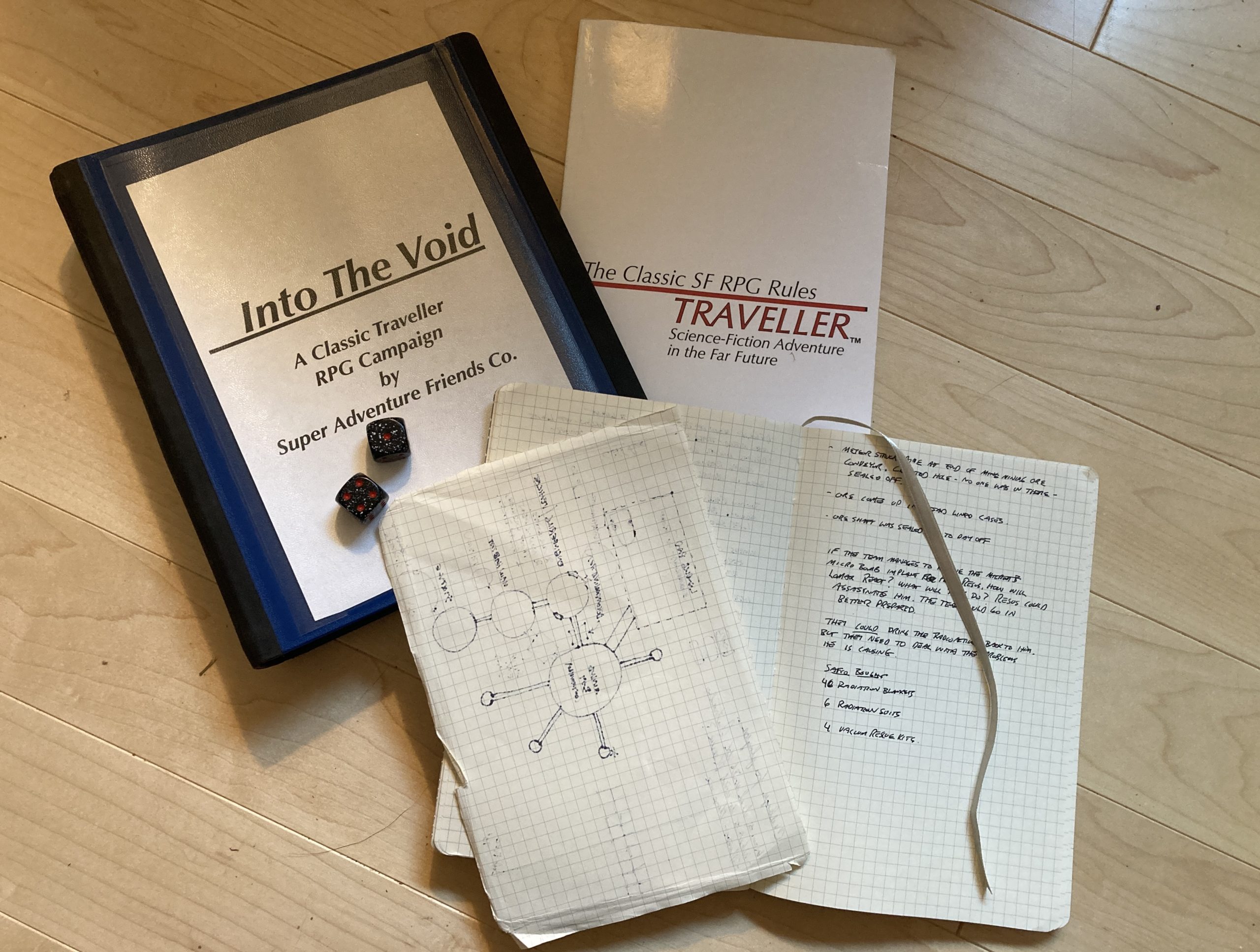
This adventure is taking way more session than I expected! That’s fine. We’re only playing for two hours at a time, and we usually spend about 10 minutes catching up before we play. I’m enjoying these sessions a lot, and I hope the players are too. It is great to not feel like we are rushing through an adventure “just to get it done.”
One challenge I had in last night’s session was keeping the one character who stayed on the ship (to make sure someone was there at the ready) engaged. William is a great player. He often is the one who goes up to the balcony to keep an eye on things, lags behind to make sure no one is following them, etc. Sometimes, as in these last few sessions, it means his character, Barney, isn’t in the middle of the action.
However, over the last seven years of playing Traveller he understands how to keep his character busy, and find productive things to do, in this case supporting the away team. I can’t believe we’ve been playing this campaign for over seven years now, but we have, and all the guys are seasoned Traveller players. Well, Todd is new, but he’s an experienced gamer and it’s like he’s been with us the whole time.
I had a good time with last night’s session. I made a random table to determine how the alien ship they are on might malfunction. Gravity going in and out, information videos suddenly playing, lights on and off, maneuvering/attitude thrusters suddenly firing. It was also fun to have the PCs in vac suits – an added level of danger, as well as some zero-g antics.
When I review my own performance as Ref after these games, I continue to be dissatisfied with the descriptions I give of things. Like the interior of the ship. I feel like I’m paying a lot of attention to the big things in a session, but could spend more time thinking of atmospheric details. I will work on that.
Going on vacation for a week. More Traveller after that.
Playing approximately once a week, online, for two hours, seems to be working out. It seems easier for the whole group to find two hours and not have to travel at all than to find travel time, then two hours or more, then more travel time. And it’s easier than finding three or four hours for online play. We’re having a good time with it, and it feels like the campaign is regaining its momentum.
In last night’s game I had decided that each time I went through the entire party, asking them what they are doing and then having them do it, would equal 10 minutes in the game, and that each of those 10 minutes would raise the interior temperature of the alien ship by 10 degrees C. The team, however, was very cautious. The time scale ended up not making any sense. I stuck to it, but it was obvious that it was all out of sync with what was actually happening. I told my players that obviously I had messed it up, but we were sticking with it rather than me retconning the session. What I should have done was either make each time through the lineup 5 minutes, or just dropped the time period all together and tied each full trip through the rotation to a temperature raise, and then GM’ed it .
Lesson learned.
As I wrote up last night’s game, I realized that as a GM, writing up the sessions in this way might be my best GM practice. It is a great tool for remembering what happened, obviously, but also keeps us kind of enthusiastic about the campaign. It is cool to look back and see all the stuff the team has done.
I have been physically kind of exhausted lately. Allergies are bad this time of year, and work has been busy. Last night I was not sure I was ready in terms of prep or just physically, but we played and my players gave me the energy to do a good job. Good players make the game.
I have been running a modified version of the classic Traveller adventure “the Chamax Horde” for the last few sessions. I say “modified”, which means I used a lot of the structure of the adventures but made it fit into our campaign a bit better. This is the second time in the history of our campaign that I’ve used someone else’s adventure, the first being the Energy Leech adventure which came from Michael Brown’s 1-page adventure Energy Transfer.
It has taken a long time to do this particular adventure due simply to not playing very often. It’s hard for players to remember important details which might help them if you wait too long between sessions.
Now that we are playing online again that may change. Last night I proposed weekly or bi-weekly sessions, Tuesday nights from 7pm – 9pm. For in-person games I always feel like two hours is not enough. Everyone has made time to go to the game location, and then you only play for two hours? That doesn’t seem right. But playing online it feels different. No one has to travel. It is more convenient. And spending two hours a week online for the campaign is not too massive a time requirement. I think it may work. We’re going to try it. Everyone wants to play more. I’d like to as well. And it is easier to prep for two-hour sessions. It’s also easier to keep the Referee-Mind sharp and on-task for shorter sessions. I think that will benefit everyone.
Last night’s game was another zero combat session. Lots of exploration, planning, problem solving. I was very happy with the way all the players were active and engaged. I didn’t have to “find stuff” for each character to do. They just got in there and made it all happen. Before the game I asked them to all review the previous few sessions for important loose ends and details. One player in particular really took that seriously and was on-point with it. I have great players, and I appreciate it!
It took almost a year to get back to the campaign, but I never end a campaign. Ever.
Session 30 was really fun, and was a reminder why I love this group so much. Since William moved to San Antonio last year we are taking the game back to Roll20 rather than in-person. I’ve not run or played a game on Roll20 since the pandemic lockdown, though I’ve kept my account and all the stuff in there. The biggest issue I’ve had with it is that putting things online is an added layer of preparation. I really like doing everything in a small notebook and using that with my small ring binder that has all the campaign materials and playing in-person. I spend a lot of time on the computer already. BUT — I have made some progress on Roll20.
I got an iPad Mini for Christmas 2024, and recently added and Apple Pencil and the application Procreate to it, and it makes creation of maps for the online game much easier. I no longer want to go jump in front of a bus every time I start working on one. I can sit in my chair, in the front room with my family, and work on the iPad. The pencil works really well too, and the application does exactly what I need it to do.
Now, while I haven’t been running this campaign for nearly a year, I have been running a D&D campaign for three players for about 8 months, so I’ve been getting a lot of GM practice. So jumping back into the Traveller game was not that hard. I was very pleased with the roleplaying done by the group. They give me so many things to riff off of during the game. I had no intention of introducing an NPC computer hacker, but they wanted to find one, so I whipped one up. The things they did that I wasn’t expecting, which was nearly everything, gave me so many options as the referee. It is kinda funny that now, at 60 years of age, I am finally understanding that if you LISTEN to your players and ride that wave the game will be a lot better, and a lot easier to run.
Classic Traveller is a great system for this kind of play. There are enough rules to get the job done, but not so many to make the game oppressive and hard to create and adjust on the fly. Cepheus Engine is the same way.
After the game we started a discussion about the Cepheus Engine, and possibly converting the campaign to the CE System Reference Document. I have already ported a lot of CE mechanics to this Classic Traveller game. I think making it official might help the players, as they’d have all the rules I’m using easily available. So I asked them, if they have the time, to fiddle around with character creation using the online version.
I do, however, ask myself how much this would improve our game. Would it improve it at all? Is it necessary? The honest answer is probably not. Classic Traveller has served us well for many years now. I really enjoy saying I run Classic Traveller. That means a lot to me.
A few notes about session 29. Not going into too much detail about specifics from the Referee’s point of view as we just started this adventure.
For the first time ever I am using a classic published adventure from the old Traveller books. Two reasons. First, I was having trouble coming up with a good way to take the game at this point. I’ve been collecting the old books, and decided what the heck, let’s do it. Second, after watching some of Seth Skorkowski’s YouTube Videos I feel like I have a new appreciation of both how good many of those published classics are and how to run them.
So if you are in my group, don’t watch Seth’s videos! I might use some of the old scenarios he talks about!
This was one of those session where we had just finished a multi-session adventure. Sometimes deciding which way to take a game is not easy. In order to make this work I needed to get the guys back into space. They had a good reason to do exactly that, but could have decided to do some other stuff first. I might have needed to improvise a better reason. But rather and try to guide them I just sat on my hands. I let them hash it out. No forcing things. If they decided to do something else I would have made a game happen by responding to them. Turns out they did exactly what the scenario needed them to do anyway, so that was cool. We got underway. Sometimes as a gamemaster you have to just let things happen. It’s always better when the PCs aren’t railroaded. I’ve got a folder full of good NPCs and ideas for encounters. I can pretty much always make fun happen with the players’ help.
But I have to admit, it is nice to have DOZENS of concise 1-page adventures from Michael Brown and almost all the classic Traveller adventures and double adventures waiting to be to used.
I had to do a little massaging of the published scenario to fit it into the game, but nothing that major. This is almost always the case. I’m not running the published Third Imperium setting. So a few minor details had to be changed. I ran into this when running the last set of sessions using Michael Brown’s Energy Transfer adventure.
Something I’ve learned from reading Michael’s adventures, and that I’ve become very comfortable with, is finding new ways for PCs to use skills, and coming up with quick rules to determine their effects. For example, allowing the navigator to use his Nav skill to accomplish more efficient travel, save time, and in this case double the amount of time they’d have to accomplish their task upon arrival. They started with 1 hour under normal navigation, but for every 1 he could make his Nav roll by, I gave them an additional hour of time to work before falling into the sun. He made it by 1, so they had 2 hours rather than 1, which helped. I let the Engineer use his skill to gain information about the status of the clearly damaged maneuver drive. This kind of skill use, I think, lets players feel like they are valuable skills. It makes the characters a lot cooler. I had the pilot make a Pilot skill roll to match the speed and attitude of the target vessel. Without that, things would have been more difficult. He has Pilot-4, but he could have failed. Spacewalks and all the rest would have been a lot harder if he’d had to constantly be making adjustments, and using the docking clamp would have been next to impossible.
Once they were inside the ship, I again had to sit on my hands and just answer questions and let them explore. So many of us have been programmed to think that constant action is what makes RPGs fun, but it’s not. Exploration, suspense, information gather, time stress. These all made the game fun.
We were one player down this session, but ran his character carefully and safely.
This was the end of a 4-session adventure. Really, it could have been added into the previous session, but I really didn’t have anything ready at the time. One good thing about running short sessions is that it allows you to react to the character’s actions well. It also draws things out a lot.
So here’s something I noticed during this session. At one point a couple of the PCs split off in the air raft, the idea being they could cover the rest of the team from a high vantage point. One of the PCs has good Rifle skill, so he was great as a sniper. The other, Barney, the engineer, was more of a lookout. Barney’s player, William, often puts his character in a lookout position. He seeks a good vantage point, and this has paid off many times for the group, whether playing Traveller or GURPS. In this particular case it didn’t hurt anything, but it didn’t help either. I could have helped, but it didn’t. As the Referee, I didn’t suddenly invent some threat for him to deal with. Things were as they were. The team had created a good plan. They’d acted rationally. There was no reason some threat would instantly materialize just to keep William entertained.
And the great thing is this: William didn’t need to be entertained. He is a long-time RPGer, and an engaged player. Like the rest of this group, he thinks of the team’s success and how he might contribute to it, rather an worrying about being the constant superstar. So as an adult RPGer, he is able to accept that the actions of his PC did not put him in the spotlight but remain engaged with the game.
I appreciate that. I am a very lucky GM to have a group like this.
“Due to reasons” it took while to get to this session. I will admit that I still have a bit of anxiety about each session. I always want it to be the best session ever. Truth is they are all good because I have a table of engaged players who make it good. You can spend all the time you want and have the most incredible stuff prepared but if you players are a bunch of house plants it will not be fun.
Anyway, our gaming group is great. I can’t say that enough.
This was the first time I’ve used a published adventure in our campaign. Though I own dozens of Michael Brown’s short adventures, and I think every one of them is brilliant, this was the first I worked into our game. Michael gives you what you need to run a fun session (or sessions) without, as he says, “stepping on the Ref’s toes.”
This was the culmination of a game spanning four sessions. Over the course of those sessions I think one shot was fired. No one was shot. There were no real “fights.” Four sessions of roleplaying and problem solving. This is actually not unusual for my campaign and this group, and I’m continually astonished at the ability of Traveller, a great gaming group, a good and flexible scenario, and and adequate referee, to create an engaging and satisfying game.
Maybe everyone else’s games are like this? I have no idea. Growing up playing a monster-killing loot-grabbing style of D&D, superhero mayhem with Champions, and murder hobo style Traveller, I’m just surprised at how well this is going. Had any of us had the skill and desire to do things this way as teens I think it would have been well-received. As it is, we have fallen into this during our middle-aged years, and that’s fine. I’m just so happy with this campaign. I can’t imagine ending it. Ever.
This was session 27. During session 26 I already knew I wanted to use the Energy Transfer adventure from Michael Brown and I had a “plan” for how it might work in. Needless to say my inventive and resourceful players did not do what thought they would (which I expected would happen). I had to do a little thinking on my feet to create a seamless transition into that scenario for session 27. I’m pretty happy with how that went. As a Traveller referee it was quite satisfying.
As often happens, we ended this series of sessions with a lot of nice loose ends. The campaign continues to generate its own internal drama with long-term NPCs, possible backstabbing and intrigue, and lots of options for the players.
Really, in all likelihood this “story” is not really complete. There are some things they will almost certainly deal with upon returning to their home base on planet Mylor. Fun awaits.
My little custom Traveller campaign notebook (sheets are all in plastic sheet protectors), Classic Traveller Facsimile Edition, and small session notebook with maps, notes, and scenario.
As I prepped for this game I thought a lot about the elegant simplicity of Classic Traveller. Being able to consolidate the important stats of all the NPCs on one page of 5.5″ x 8″ notebook is a hell of a lot simpler than having character record sheets all over the place. I love my games with more complicated characters, but the simplicity of Classic Traveller is nice. It’s genius, really. Marc Miller is a freaking genius. Looking at newer versions of Traveller, Cepheus Engine, and some of the variations on CE like Sword of Cepheus I can see the influence. They are all a bit more complex, but not that much! A Sword of Cepheus character, even one with a lot of spellcasting ability, could easily fit on a note card.
The thing is, when I’m running a game I like all my stuff to be concise and very easy to locate. This is why I’ve taken some rules from the Classic Traveller books as well as the Cepheus Engine stuff and made my own little 5.5″ x 8.5″ binder. The rules we use a lot are all there, as are all the PCs, the important NPCs, the ships, the planets, and the gear. With that notebook, a small notebook with my scenario notes and maps, a copy of the Classic Traveller Facsimile Edition, and a copy of Cepheus Deluxe or Light, I’m mostly ready to go. I typically bring the Mongoose Traveller Central Supply Catalog along, as well as the Cepheus Engine vehicles book just in case I need it.
Sessions 25 and 25 of our campaign may have had the fewest rolls of dice ever. That being said, I think they were good sessions. There was a lot of discussion, decision making, and roleplaying, which I think is the point really.
As this goes on I am more and more impressed with our gaming group. They are just great players. Given the choice, they will always discuss things and make good decisions. When something surprises them and they have no time to mess around they take action.
That’s about all I have to say, other than express my frustration that we can’t play every week.
Well, the PCs have only been back on their home base planet of Mylor for a few hours before they are back in the middle of it again!
Oh, before I forget, this was our first session back in Meat Space in over two years. We played in person.
So, so fun. I wasn’t sure how to start this session(s) when I began thinking about it a couple of weeks ago. They are back in civilized space. Back to their old watering hole the Happy Gluck. Back to old associates, frenemies, and complications. So I started this with a simple title for the session “One Night at the Happy Gluck.” Who doesn’t like a game where a relaxing night at the tavern turns to chaos?
So I came up with some ideas of ways to involve their existing friends and associates at the star port, what could have gone wrong during their absence, and some new NPCs. One goal, after 9 sessions (taking several months to play) in uncharted space was to reintroduce the players to the NPCs in the game. As you will see if you read the writeup, they are going to try to rescue the guy who tried to have them killed nine games back. Which is awesome! I love it. Complex relationships in an RPG. To me, well, this is a huge success for me as the Referee. I am delighted.
We were able to use some of the PC’s more social skills. They of course used tactics even in the tavern, and everyone seemed fully engaged.
I think we are all getting better at this game. I have stated before in numerous places that now, 4.5 years into our campaign and now 24 sessions in, my players are just now really getting the groove of Traveller. Well, that isn’t entirely correct. They have always played the game very well. I guess what I sense is the buildup of the in-game history and lore of their campaign. I’ve run a lot of RPG campaigns in my life, but I don’t think any have reached this level of complexity or been this satisfying. My players of course love it when action happens, but they are equally engaged when they are roleplaying, scheming, negotiating, threatening, sneaking, or investigating.
I think that when everyone is really used to the idea of not leveling up all the time, and not worrying about experience points, the game can unfold in a very natural way.
When new players start with Traveller, I suspect that many are shocked and disappointed by the limits placed on them. No FTL communication. Space travel is expensive and takes a long time. You don’t hop in your ship and get to the other side of the galaxy in 2 hours. You probably use slug throwers for guns, and bladed weapons too. Ship combat is very expensive even if you win, and very prone to getting you killed. While psionics may exist, you probably don’t have that talent. You have to worry about money. AND — you are a fairly typical person. Oh, you ARE a Traveller, and thus more accomplished than trillions who never leave their homeworld, but you are mortal. You will never become that hard to kill. The list goes on.
All of this kind of flies in the face of science fantasy and a lot of science fiction. Because we are talking about limits, and I think it is the limits in Traveller that make the game challenging and fun.
I’m glad I have a group of friends who can enjoy all this.
Anyway, this session was the opening of yet another adventure for Super Adventure Friends Co. We are back to our original core group of 3 ex-Scouts and 1 former Army colonel. Four players is very manageable. We’ll certainly play online from time to time and I can get our member in Virginia back involved, and our other regular local member of our gaming group can play whenever he wants (with a little prior notice). It’s all going well.
After a few months of home remodeling and whatnot, we finally played today. We had planned an in-person meeting, but one of our players had a family member with Covid last week so we opted for online. That family member is fine. Thankfully they are testing negative and are well.
A few notes about this session. Not really any action. I had action planned, but as will happen in an RPG the players were very smart and took a lot of time carefully planning and roleplaying some non-action stuff. The result was great problem solving and skill use, and everyone was fully engaged. There was just no shooting. Now, they were still dealing with the unknown, so the threat of danger is always there. That is fun. That is suspenseful.
This was session 23. The players started this expedition in Session 15. So that is 9 sessions. That is the longest sustained single “adventure” I’ve ever run. I’ve always found “quests” to be difficult to run. They always seem fun for the first few games, then the quest itself feels like a straight jacket for me as a ref. I feel like everyone is getting tired of it. I didn’t feel like that this time. I am glad the expedition is complete and they are back in charted space, but it was fun the whole time.
Likewise, this is the longest campaign I’ve ever run in real time or in game sessions. Granted, we haven’t played THAT many sessions, but we’ve been at it for several years. Adult life has gotten in the way a lot, but we’ve kept at it, and we’ve reached a point that the campaign has developed its own history, and with the discovery of a real threat to the Imperium during the expedition, the PCs have for the first time done something that could potentially affect the entire Imperium. That is very cool, and I really didn’t plan it. After the encounter in sessions 20 and 21 with the sentient planet-wide psionic fungal network, I listened to Marc Miller’s novel Agent of the Imperium, and realized they had discovered something that needs the attention of the highest-level decision makers. That is very cool.
I’ve heard many podcasts speakers talk about story telling in their games. That is cool. But I don’t feel like a story teller. I think of my GMing as creating a game — creating situations and problems for my players to contend with and solve using their characters and resources. Clearly there is a story, but the story emerges from the play. Today I had no idea what they would do. I set the stage, the dice and rules and I are the world, and the players interact with it. It is nice if I come up with something brilliant and entertaining, but I’m not writing a story.
However, if you are, and your players dig it, that is great. I’ve just been reflected a bit on how I do things and the way I think about things. That’s all.
Anyway, the team got back to their base planet, took care of some stuff like getting paid, passing information on to the proper authorities, and are new all set up for the next game, which more than likely will involve some action and craziness.
After the session, I had all the players add the skills their characters have been studying for the last 4 years of real time permanently to their characters. Character improvements in Classic Traveller are hard to get, and it has just been a great campaign so far, so I just had them add the skills. No roll. Just some improvement. They can now decide what 2 skills they will study during the next 10 or 20 sessions.